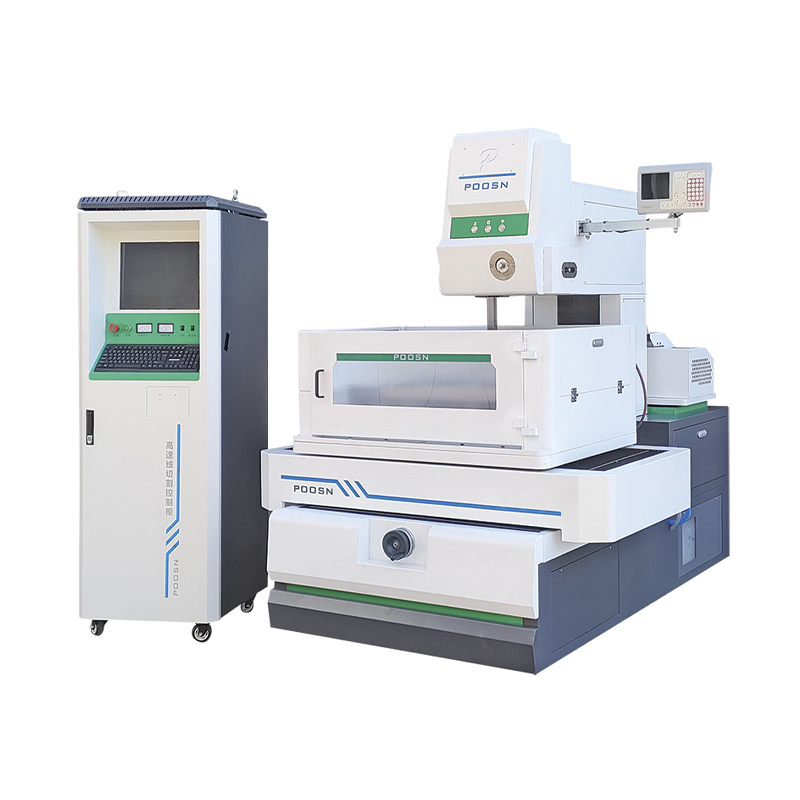
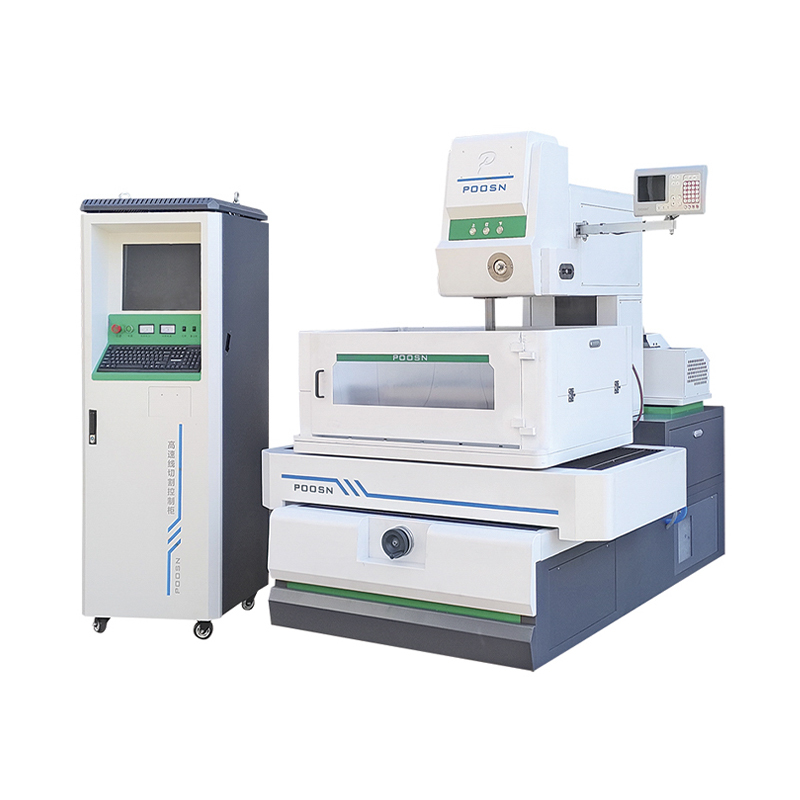
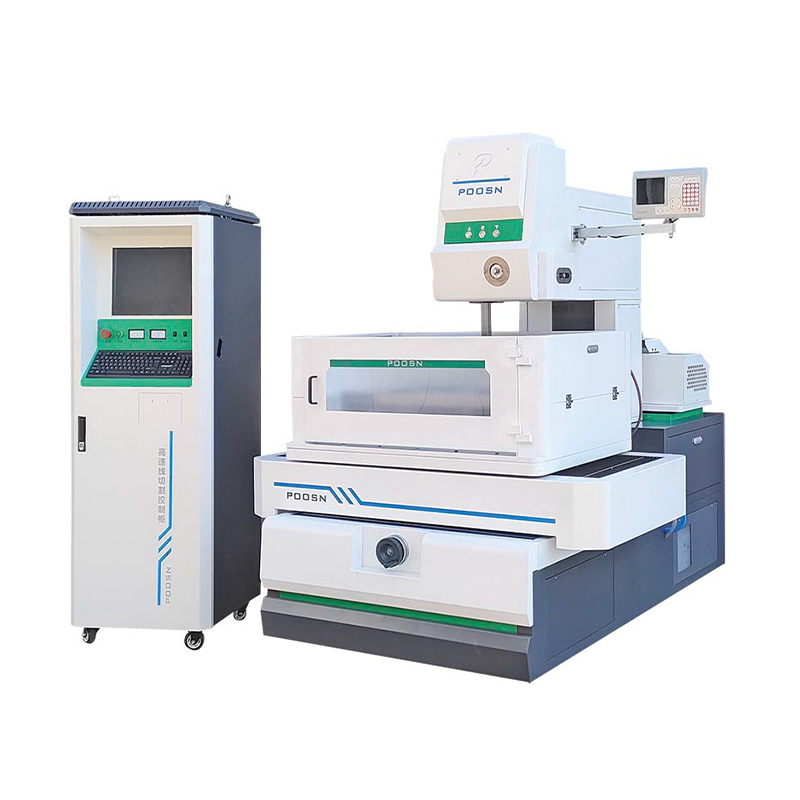
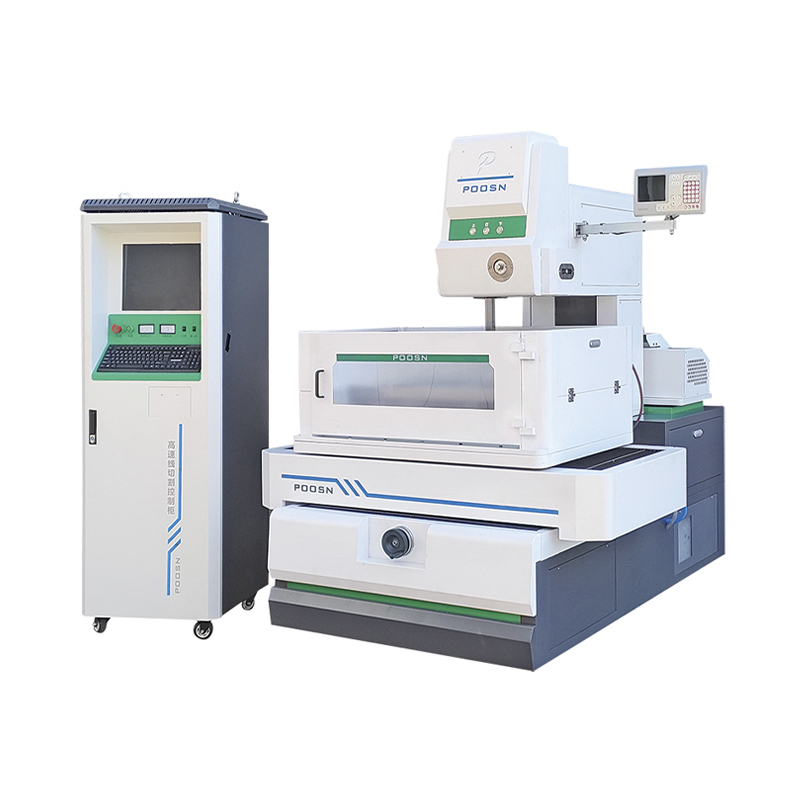
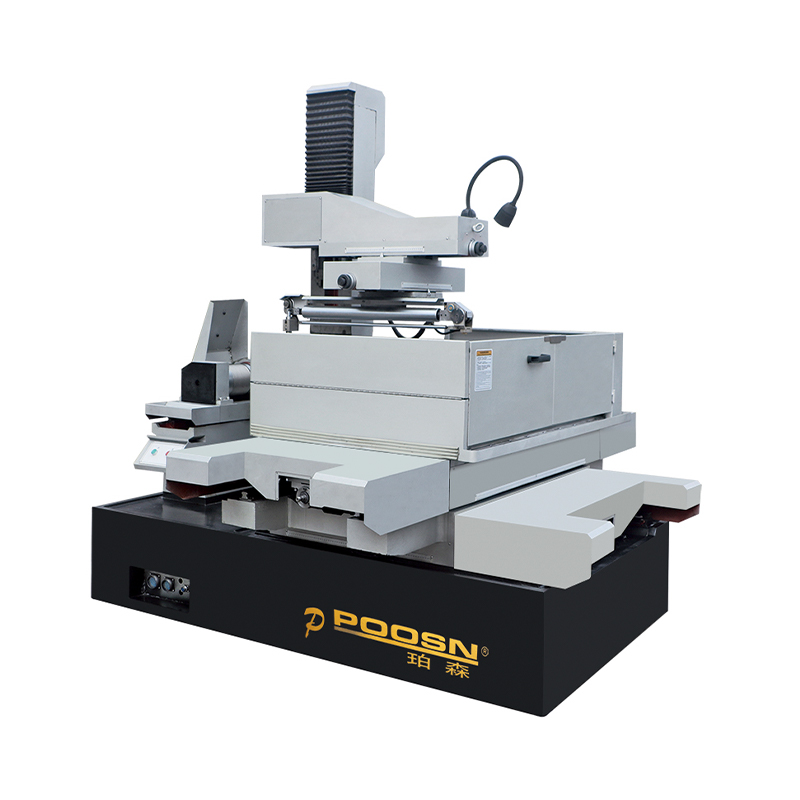
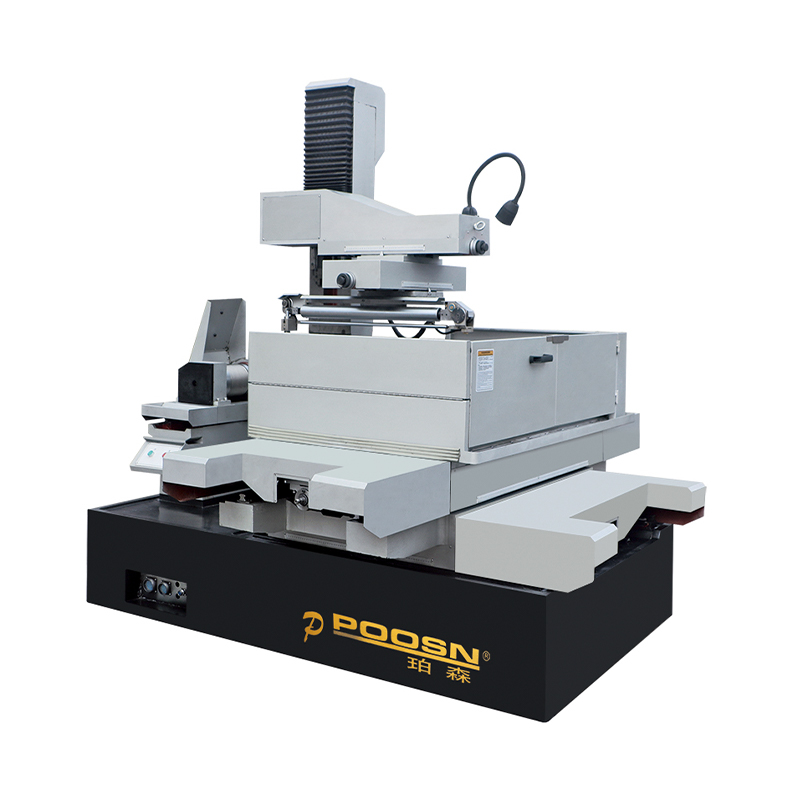
A CNC wire cut machine, also known as a wire cut EDM machine or an EDM wire eroder, is a piece of precision manufacturing equipment that uses a thin, continuously moving metal wire as an electrode to erode conductive material through controlled electrical sparks. Rather than physically shearing or grinding metal the way a saw or a mill does, the machine relies on rapid electrical discharges between the wire and the workpiece, both submerged in or flushed with a dielectric fluid, to vaporize tiny amounts of material along a programmed path. Because the wire never physically touches the part with mechanical force, this wire EDM equipment can cut hardened steel, tungsten carbide, and other difficult alloys without inducing the stress, distortion, or tool wear that conventional cutting methods often produce. The entire cutting path is guided by a CNC controller, which reads a digital program and coordinates the X and Y axes with sub-millimeter positioning so that even highly intricate profiles, internal corners, and narrow slots can be reproduced with consistent repeatability.
In short, a CNC wire cut machine is the modern, computer-controlled evolution of wire electrical discharge machining, and it is now a standard fixture in mold shops, tool rooms, and precision component manufacturers around the world. The remainder of this article explains how the process works, what a wire cut EDM machine is built from, how different machine categories compare, and how manufacturers such as Taizhou Xinchengyang Machinery Manufacturing Co., Ltd apply this technology across a range of medium-speed, high-speed, and large-taper wire EDM equipment.
How a CNC Wire Cut EDM Machine Works: The Spark Erosion Process
The working principle behind every wire cut EDM machine is called spark erosion, or electrical discharge machining. A thin wire, typically brass or coated molybdenum, is fed continuously from a spool through an upper and a lower wire guide, forming a taut electrode that travels vertically through the workpiece. A carefully controlled voltage is applied between the wire and the conductive workpiece, and when the gap between them becomes small enough, an electrical spark jumps across the gap. Each spark generates intense localized heat, reported in engineering literature to reach several thousand degrees Celsius at the point of discharge, which melts and vaporizes a microscopic amount of material from both the wire and the workpiece surface.
Because this process repeats itself tens of thousands of times per second, the accumulated erosion along the programmed toolpath gradually cuts a complete profile through the material. The dielectric fluid, usually deionized water in wire cutting applications, flows continuously through the cutting zone to cool the wire, flush away eroded particles, and help restore the insulating gap between sparks so the cycle can repeat in a controlled manner. Because there is no direct mechanical contact between the wire electrode and the part, the workpiece experiences essentially no cutting force, which is one of the central reasons wire EDM equipment is favored for delicate, thin-walled, or already-hardened components that would otherwise deform under a milling cutter.
The CNC control system is what elevates this process from a manual spark-cutting technique into a repeatable, programmable manufacturing method. A servo-driven positioning system continuously monitors the spark gap and adjusts the X-Y table in real time, advancing the wire only as fast as stable sparking allows. This closed-loop feedback is the reason CNC wire cut machines can reproduce the same complex profile across hundreds of parts with very little variation, which is essential for tool-and-die production, stamping components, and other applications where interchangeability matters.
Core Structure and Components of a Wire Cut EDM System
Although designs vary between manufacturers, most CNC wire cut machines share the same fundamental architecture. Understanding these components helps operators, buyers, and maintenance staff appreciate why certain machine categories are better suited to particular jobs. The simplified isometric schematic below illustrates the main functional groups found on a typical wire cut EDM machine, followed by a numbered explanation of each part.
Worktank and dielectric fluid reservoir - holds the deionized water that flushes the cutting zone and stabilizes the discharge gap.
X-Y precision cross table - the servo-driven platform that positions the workpiece according to the CNC program.
Upper wire guide head - directs the wire electrode into the cutting zone and, on tapering-capable models, can tilt independently.
Lower wire guide head - keeps wire tension and alignment consistent beneath the workpiece during the cut.
Automatic wire spool and feed system - supplies fresh wire continuously and manages take-up after each pass.
CNC control cabinet - houses the numerical controller, pulse power supply, and servo drives that manage the entire wire cut edm cycle.
Workpiece fixture - clamps the part securely on the cross table to maintain positional accuracy throughout the cut.
Types of CNC Wire Cut EDM Equipment: Medium-Speed, High-Speed and Large-Taper Machines
Not every wire cut edm machine is built for the same job, and manufacturers generally group wire EDM equipment into a few broad categories based on wire handling method, cutting speed, and taper capability. Medium-speed wire cut machines reuse the same length of molybdenum wire multiple times, which keeps electrode consumption low and makes this category well suited to general tool room work, mold inserts, and stamping die components where moderate throughput and dependable repeatability are the priority. High-speed wire cut machines are engineered around faster pulse frequencies and more aggressive servo response, allowing continuous cutting of hardened steel and carbide at a higher throughput, which benefits production environments that need to process larger batches without sacrificing dimensional consistency.
Large-taper wire cut machines add an additional layer of capability: the upper wire guide head can tilt through an extended range relative to the lower guide, allowing the machine to cut angled or draft profiles rather than only straight vertical walls. This is particularly relevant for stamping dies, extrusion dies, and blanking tools where the upper and lower faces of a cavity need a deliberate offset. Taizhou Xinchengyang Machinery Manufacturing Co., Ltd produces representative equipment across all three categories, including the PS-C and DK77-BC series of medium-speed wire cutting EDM machines, the DK77-A and DK77-B series of high-speed wire cutting EDM machines, and the DK77-D series of large-taper wire cutting EDM machines, giving tool rooms and production shops a range of options depending on part geometry and throughput requirements.
General comparison of wire cut EDM machine categories and their typical production focus
Machine Category
Wire Handling
Typical Focus
Representative Series
Medium-Speed Wire EDM
Reciprocating molybdenum wire
General tool room and mold insert work
PS-C, DK77-BC
High-Speed Wire EDM
Higher pulse frequency cutting
Continuous production of hardened parts
DK77-A, DK77-B
Large-Taper Wire EDM
Independent upper and lower guide travel
Draft-angle dies, blanking and extrusion tooling
DK77-D
Illustrative Composition of a Wire EDM Cutting Cycle
The ring chart above represents a commonly used, illustrative breakdown of how machining time is typically distributed across a multi-pass wire cut edm cycle, rather than a fixed figure that applies to every job. The largest share of time is generally consumed by the rough, or main, cut, since this initial pass is responsible for removing the bulk of the material along the programmed profile while the wire operates at higher energy settings. Once the rough profile exists, one or more skim passes follow at progressively lower energy and slower feed, and each successive pass removes only a thin layer of material left behind by the previous one. This staged approach is precisely how wire EDM equipment achieves both a clean dimensional profile and a refined surface finish without over-stressing the wire electrode. The proportion allocated to skim passes tends to grow when a part specification calls for tighter tolerances or a smoother finish, while simpler, lower-tolerance profiles can often be completed with a shorter rough cut and a single light skim pass. Recognizing this general pattern helps shop planners estimate cycle times more realistically when quoting wire cut edm work for new tooling projects.
Achievable Accuracy and Surface Finish in Wire Cut EDM
One of the primary reasons manufacturers choose a CNC wire cut machine over conventional milling is the level of dimensional accuracy the process can sustain on hardened or difficult-to-cut materials. According to widely reported figures across precision machining literature, standard wire EDM production commonly holds tolerances in the range of about plus or minus 0.002 to 0.01 millimeters under normal shop conditions, while carefully controlled setups using additional skim passes can tighten that further, with some high-end equipment approaching positional accuracy of roughly 0.001 to 0.005 millimeters. These figures depend heavily on part thickness, wire diameter, thermal stability of the shop environment, and the number of finishing passes applied, so actual results will always vary from job to job.
Surface finish follows a similar staged improvement. Industry sources commonly report that a rough wire EDM cut leaves a surface roughness in the neighborhood of a few microns Ra, while subsequent skim passes progressively refine that surface, with typical finished results falling between about Ra 0.2 and 1.0 micrometers, and optimized multi-pass setups on suitable materials sometimes reaching finer values still. This staged refinement is why wire cut edm is frequently selected for mold cavities, die inserts, and other components where a smooth as-cut surface reduces or eliminates the need for secondary polishing. It is worth noting that no single number applies universally across every material and machine combination, and actual tolerance and finish targets should always be confirmed against the specific part drawing, material grade, and inspection method being used.
Surface Finish Improvement Across Cutting Passes
This stacked bar chart illustrates, in a relative and simplified way, how the balance between rough cutting and skim passes tends to shift between a medium-speed wire EDM machine and a high-speed wire EDM machine. Medium-speed equipment, which typically reuses the wire electrode across multiple passes, is often applied to work where finish quality is a priority, so a proportionally larger share of the total cycle is dedicated to skim passes that refine the surface. High-speed machines, in contrast, are frequently deployed in continuous production settings where throughput matters most, so a larger share of the cutting cycle is spent on the initial rough profile, with lighter finishing applied only where the part specification requires it. Neither approach is inherently superior, since the right balance depends entirely on the tolerance, surface finish, and volume requirements of the specific part being produced. What the chart does highlight is that wire EDM equipment is flexible enough to be tuned toward either finish quality or cutting speed depending on how the pass strategy is programmed. Shops that run a mix of mold work and production stamping components often keep both machine categories available so that jobs can be routed to whichever configuration best matches the part requirements.
Materials That Can Be Processed on a Wire Cut EDM Machine
Because the wire cut edm process relies on electrical conductivity rather than mechanical hardness to remove material, it can process a considerably wider range of difficult alloys than conventional cutting tools can handle economically. Any electrically conductive material can, in principle, be cut on a CNC wire cut machine, and the hardness of the workpiece has comparatively little effect on cutting feasibility, which is one of the process's most valuable characteristics for tool and die work.
Tool and die steels - including hardened grades used for stamping dies, mold cores, and cutting punches.
Tungsten carbide - commonly used for wear-resistant tooling and cutting inserts that are difficult to machine conventionally.
Titanium alloys - widely applied in aerospace and medical components where strength-to-weight ratio matters.
Copper and brass - frequently used for EDM electrodes and electrical connector components.
Aluminum alloys - suited to prototyping, fixtures, and lightweight mechanical parts.
Superalloys - nickel and cobalt based alloys used in high-temperature turbine and energy sector components.
This broad material range is exactly why wire cut edm equipment has become common not only in mold and die shops, but also in aerospace component manufacturing, medical device production, and electronics manufacturing, where designers regularly specify hardened or exotic conductive alloys that would be slow, costly, or risky to machine using traditional cutting tools. Because the process does not depend on tool hardness relative to the workpiece, a wire EDM machine can cut fully hardened tool steel just as readily as it cuts softer aluminum, which removes a major planning constraint that conventional machining shops must otherwise work around through heat-treatment sequencing.
Wire Diameter and Precision Trade-Offs in Wire EDM Cutting
This scatter plot illustrates the general relationship between wire electrode diameter and the level of precision a wire cut edm machine can realistically achieve. Finer micro-wires, down to around 0.02 millimeters in diameter, allow the electrode to trace tighter internal corners and finer detail, which is why micro-EDM applications favor these ultra-thin wires despite their slower cutting speed and more delicate handling requirements. As wire diameter increases toward the commonly used standard sizes of roughly 0.15 to 0.25 millimeters, the kerf width naturally widens and the achievable positional tolerance loosens somewhat, but cutting speed and wire durability both improve, which is why standard brass wire remains the most widely used option for general tool room work. Heavier wire around 0.3 millimeters is typically reserved for rough, high-throughput cutting of larger, less detail-sensitive profiles, where cutting speed matters more than fine internal geometry. This trade-off is not a fixed rule but a general tendency observed across wire EDM equipment, and the right wire selection always depends on the specific corner radii, material thickness, and tolerance requirements of the part being produced. Operators frequently select a coarser wire for the rough pass and then switch to a finer wire or apply additional skim passes when a feature calls for tighter accuracy.
Advantages of CNC Wire Cutting Over Conventional Machining Methods
CNC wire cutting offers several practical advantages compared with conventional milling, grinding, or sawing, particularly when a part is hardened, delicate, or geometrically complex. These advantages are the reason wire cut edm has become a standard process in tool rooms rather than a niche specialty technique.
No mechanical cutting force - the wire never physically presses against the part, which avoids the distortion, chatter, and mechanical stress that cutting tools can introduce.
Ability to machine fully hardened materials without the tool wear problems that conventional cutters experience on hard steel and carbide.
Capability to cut complex, intricate profiles including internal corners and narrow slots that would be difficult to reach with a rotating cutter.
Repeatable, burr-reduced edges that often require little or no secondary finishing before a part is ready for assembly.
Reduced material waste, since the wire itself is thin and the kerf removed along the cutting path is narrow compared with many mechanical cutting processes.
Straightforward programming from CAD geometry, allowing consistent reproduction of the same profile across a production run.
These strengths do come with trade-offs worth acknowledging honestly. Wire EDM generally removes material more slowly than milling when the job is primarily bulk material removal on soft, easy-to-machine metal, so shops typically reserve wire cutting for profile work, hardened materials, or geometries that conventional tools cannot reach rather than for every operation on every part. Understanding when to apply wire cut edm and when to rely on conventional machining is part of good process planning, and many tool rooms use both methods together within the same production sequence to get the benefits of each.
Typical Positional Accuracy Achieved by Modern Wire Cut EDM Machines
This gauge summarizes, in a general and illustrative way, the range of positional accuracy that modern CNC wire cut machines are commonly reported to achieve, moving from a high-precision zone on the left through a standard precision zone on the right. Under normal production conditions with an appropriate number of skim passes, tolerances in the neighborhood of a few thousandths of a millimeter are frequently cited across engineering references, and the needle position reflects a middle-ground figure often described as commonly achievable rather than a guaranteed outcome for every job. Tighter figures toward the left side of the gauge are associated with high-end equipment, thinner wire, additional finishing passes, and tightly controlled thermal conditions in the shop. Figures toward the right side of the gauge are more typical of straightforward production cutting where a single rough pass and a light skim are sufficient for the part's function. It is important to remember that actual accuracy on any given job depends on material, part thickness, wire diameter, fixturing, and environmental stability, so this gauge should be read as a general orientation rather than a specification for a particular machine or part.
How to Select the Right Wire Cut EDM Equipment for Your Production Needs
Choosing among medium-speed, high-speed, and large-taper wire EDM equipment starts with a clear understanding of the parts a shop expects to produce. A tool room that mainly services mold inserts and general tooling with moderate batch sizes will often find a medium-speed wire cut machine, such as a PS-C or DK77-BC series unit, well matched to its daily workload, since these machines emphasize dependable repeatability and economical wire consumption. A production environment running continuous batches of hardened stamping components, where throughput has a direct impact on delivery schedules, is more likely to benefit from a high-speed wire cut machine such as the DK77-A or DK77-B series, which is engineered for sustained cutting at a higher pace.
Shops that regularly produce dies with a deliberate draft angle between the upper and lower faces, such as blanking dies or extrusion tooling, should evaluate a large-taper wire cut machine like the DK77-D series, since the extended independent travel of the upper and lower wire guide heads is specifically built to hold accuracy across an angled profile rather than only a straight vertical wall. Beyond machine category, buyers should also weigh work envelope size relative to the largest parts expected, the level of automation needed for unattended operation, and the availability of local technical support and spare parts, since ongoing service quality often matters as much as the initial specification sheet. A rational, needs-based comparison across these factors, rather than choosing based on a single headline specification, generally leads to a better long-term fit between the wire cut edm equipment and the shop's actual production mix.
Industry Trends Shaping Wire EDM and CNC Wire Cutting Technology
Several broad trends continue to shape how wire cut edm equipment is designed and applied across manufacturing sectors. Growing demand from aerospace and medical device manufacturing, both of which frequently specify hardened or exotic conductive alloys with tight tolerance and surface finish requirements, continues to push machine builders toward finer wire handling, more stable thermal control, and improved automatic wire threading systems that reduce downtime between cuts. At the same time, mold and die shops serving automotive and consumer product manufacturers continue to rely on wire EDM for cavity and insert work, keeping demand steady for dependable medium-speed and high-speed wire cutting equipment.
Automation is another consistent theme across the industry, with more wire cut edm machines incorporating automatic wire threading, unattended multi-part cutting programs, and closed-loop process monitoring so that a single operator can oversee several machines running longer, less-supervised production cycles. Improved servo control and adaptive spark-gap monitoring have also gradually extended the practical accuracy and surface finish achievable on standard production machines, narrowing the gap between what once required specialized high-precision equipment and what is now available on more broadly accessible wire EDM equipment. As global supply chains continue to value parts that combine tight tolerances with hardened, corrosion-resistant materials, wire cut edm technology is likely to remain a core capability across tool rooms and precision component manufacturers for the foreseeable future.
About Taizhou Xinchengyang Machinery Manufacturing Co., Ltd
Taizhou Xinchengyang Machinery Manufacturing Co., Ltd is a specialized manufacturer with years of experience in the research, development, and production of electrical discharge machining equipment, special processing technologies, and related tooling. The company maintains strong technical capabilities, advanced processing equipment, and comprehensive testing methods that support a rational and consistent approach to product design across its wire cut edm lineup. Every machine tool produced by the company is manufactured in accordance with applicable national standards, and each unit undergoes positioning accuracy testing before it leaves the factory, which helps ensure a consistent baseline of quality across the production line.
The company's main product lines span the full range of wire cutting applications discussed in this article, including the PS-C and DK77-BC series of medium-speed wire cutting EDM machines, the DK77-A and DK77-B series of high-speed wire cutting EDM machines, and the DK77-D series of large-taper wire cutting EDM machines. This range allows customers to select equipment suited to general tool room work, higher-throughput production, or angled die cutting, all from a single, consistent manufacturing source. Products from Taizhou Xinchengyang Machinery Manufacturing Co., Ltd are sold nationwide across China, with select models exported to Southeast Asia, West Asia, Europe, and the Americas. Guided by a principle of quality first and customer focus, the company operates with a market-oriented approach and a stated commitment to serving customers with attentive, responsive support throughout the equipment lifecycle.
Frequently Asked Questions
Q1: What is a CNC wire cut machine used for?
A CNC wire cut machine is used to cut precise profiles, cavities, and slots in electrically conductive materials, and it is especially common in mold and die making, stamping tool production, and precision component manufacturing.
Q2: What materials can a wire cut EDM machine process?
Any electrically conductive material can generally be processed, including hardened tool steel, tungsten carbide, titanium, copper, brass, and aluminum alloys, regardless of the material's hardness.
Q3: How accurate is wire EDM compared to CNC milling?
Wire EDM commonly achieves finer tolerances on hardened materials than conventional milling, since there is no mechanical cutting force involved, though actual accuracy always depends on the specific machine, material, and process setup.
Q4: What is the difference between medium-speed and high-speed wire EDM?
Medium-speed wire EDM reuses the wire electrode across multiple passes and suits general tool room work, while high-speed wire EDM is built for faster, continuous cutting in higher-throughput production settings.
Q5: Can wire EDM cut large taper angles for die work?
Yes, large-taper wire cut machines are specifically designed with extended, independent upper and lower wire guide travel to hold accuracy across angled or draft profiles used in dies such as blanking and extrusion tooling.
Q6: Does wire cut EDM require special maintenance?
Routine maintenance typically includes monitoring dielectric fluid cleanliness, checking wire guide wear, and confirming positioning accuracy periodically, which helps the machine maintain consistent cutting results over time.